Inquiry
Form loading...

Why Choose Alumina Granules for Industrial Applications?

Why Choose Alumina Granules for Industrial Applications?

Industrial materials must survive heat, pressure, abrasion, and repeated handling. Alumina Granules are designed for these demanding conditions. Their high hardness supports wear-resistant surfaces, while their thermal stability suits high-temperature processing. In furnaces, reactors, filtration systems, and engineered ceramics, particle size can influence flow, packing, and final strength.

Professor Richard J. Brook, a recognized authority on alumina ceramics, once stated, “The properties of alumina depend strongly on its processing history.” This observation remains practical today. Granules are not simply crushed powder. Their purity, shape, moisture level, and distribution affect production results. A consistent batch can move through a hopper smoothly. An inconsistent batch may bridge, segregate, or create weak areas after firing.

The choice still requires careful judgment. Higher purity is not always the only answer. Cost, forming method, firing temperature, and end-use stress must also be considered. A dense ceramic component may need different granules from a porous filter body. Small differences matter.

In real plants, operators often notice the details first. Dust around a feeder. Uneven mold filling. A surface that wears sooner than expected. These signs deserve investigation, not quick assumptions. Alumina Granules offer strong technical advantages, but performance depends on correct specification and controlled handling. The material helps. Process discipline decides the outcome.
Why Choose Alumina Granules for Industrial Applications?

What Alumina Granules Are and How They Are Produced

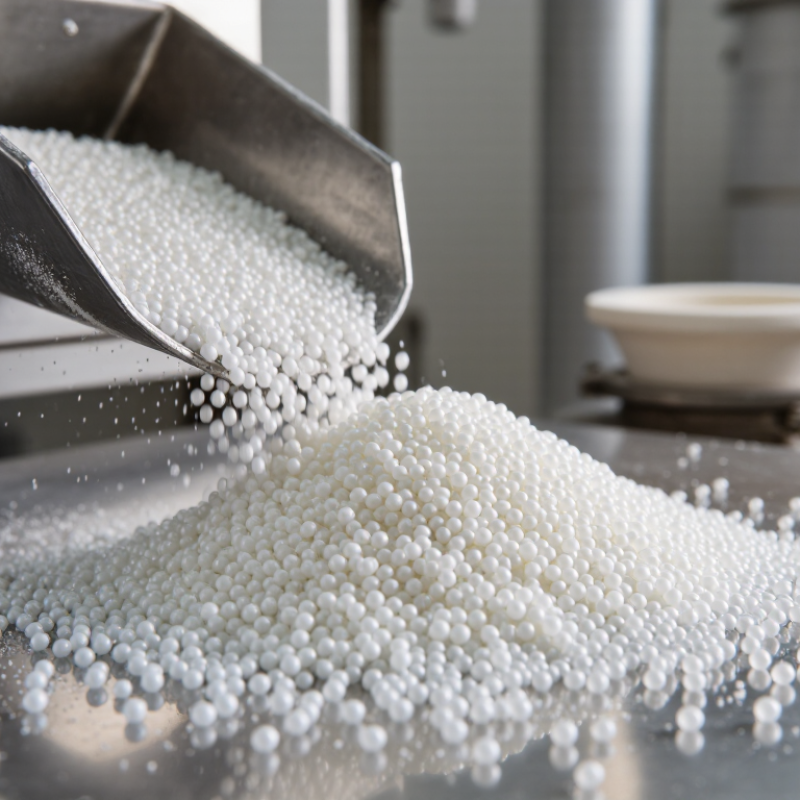
Alumina granules are shaped particles made from aluminium oxide, or Al₂O₃. They are usually produced from bauxite through the Bayer process. During digestion, hot caustic soda dissolves aluminium-bearing minerals. Insoluble residues are removed during clarification. Aluminium hydroxide then precipitates from the purified liquor. Finally, calcination removes chemically bound water and creates alumina powder.

That powder is formed into granules through spray drying, pan granulation, extrusion, or controlled agglomeration. Moisture, binder content, temperature, and rotation speed influence the final size and strength.

A typical industrial granule may measure between 0.5 and 5 millimetres. The International Aluminium Institute reported global alumina production of about 140 million tonnes in 2023. This scale reflects alumina’s importance in refractories, technical ceramics, catalysts, and filtration media. It also shows why consistent feedstock matters.

Granule size affects flow.
Porosity affects performance.

A larger granule is not automatically better. Engineers must match particle size, surface area, crush strength, and purity to the application. ASTM testing methods can evaluate abrasion, moisture, and particle distribution, but laboratory results may not fully represent plant conditions. Handling vibration, humidity, and repeated thermal cycling can expose weaknesses. The material looks simple. Its production is not.

Key Physical and Chemical Properties of Alumina Granules

Why Choose Alumina Granules for Industrial Applications?

Alumina granules are valued for their stable physical structure and dependable chemical behavior. Their main component, aluminum oxide, provides high hardness and strong resistance to wear. This helps granules maintain their shape inside reactors, filters, and drying systems. Thermal stability is another advantage. Alumina can perform under high temperatures without melting or decomposing easily.

They are not indestructible. Repeated impacts may create fines, especially during loading and pneumatic transfer. Particle size directly affects pressure drop, contact area, and flow performance. Smaller granules offer more surface area, while larger granules usually allow better gas movement. Porosity also matters because it controls adsorption capacity and internal diffusion. At the plant level, bulk density and crush strength deserve careful measurement. Small differences can change operating results.

Chemically, alumina is generally resistant to many acids, solvents, and industrial gases. Its surface can also show acidic or basic behavior, depending on purity, treatment, and moisture. It is often considered inert, but that description needs caution. Strong alkaline conditions may attack alumina over time. Impurities such as silica, iron oxides, or sodium can influence stability and surface activity. I would not choose granules from a general specification alone. A reliable decision should compare particle distribution, moisture content, attrition, purity, and performance under actual process conditions. Laboratory data may look excellent, yet field handling can reveal unexpected weaknesses.

Why Choose Alumina Granules for Industrial Applications?

Key Physical and Chemical Properties of Alumina Granules

The chart shows representative theoretical densities for common alumina purity levels. Higher-purity alumina generally provides greater density, excellent hardness, high wear resistance, and improved chemical stability. Alumina has a Mohs hardness of approximately 9 and a melting point near 2,072°C, making alumina granules suitable for abrasive, refractory, filtration, catalyst-support, and high-temperature applications. Actual granule bulk density depends on particle size, porosity, and packing conditions.

Major Industrial Applications of Alumina Granules

Alumina granules serve demanding industrial processes because they combine hardness, thermal stability, and chemical resistance. The USGS Mineral Commodity Summaries 2025 estimated global alumina production at about 145 million metric tons in 2024. This scale reflects alumina’s central role in aluminum refining and wider manufacturing.

In refractory linings, alumina granules protect furnaces, ladles, and kiln zones exposed to heat and abrasion. Dense grades can support temperatures above 1,500°C, depending on composition and binder design. Ceramic producers use controlled granule sizes for spark-plug bodies, wear parts, and electrical insulators. Abrasive manufacturers also select alumina for cutting, blasting, and surface finishing. Water-treatment systems may use activated alumina granules to reduce fluoride and moisture. Performance varies sharply with porosity, purity, and particle distribution. One overlooked issue is dust generation during handling. It can reduce yield and complicate workplace control.

Tips: Match granule size to the process, not the product label. Check alumina content, bulk density, crushing strength, and moisture before purchasing. ASTM testing methods can improve comparison between suppliers. The International Aluminium Institute reported global alumina refining remained above 140 million tonnes annually in recent years, but volume alone does not prove application quality. Trial batches still matter. A material that performs well in a furnace may behave poorly in filtration. Careful testing prevents expensive assumptions.

Performance, Safety, and Environmental Advantages

Alumina granules combine stable performance with practical handling. Their high hardness supports abrasion-resistant linings, filtration beds, and catalyst carriers. In drying systems, activated alumina can capture moisture from compressed air and industrial gases. This reduces corrosion risks inside valves, pipes, and storage equipment. Particle size also matters. Uniform granules improve airflow and reduce pressure swings during operation.

Safety depends on disciplined handling. Alumina is nonflammable and chemically stable under many process conditions. However, fine dust can irritate the eyes and respiratory system. Enclosed transfer points, local exhaust ventilation, and suitable respiratory protection remain necessary. The National Institute for Occupational Safety and Health recommends controlling nuisance dust at its source, not relying only on personal equipment. Small details matter. A cracked bag can create a visible dust cloud within seconds.

Environmental performance is more complicated. Durable granules can remain effective through repeated service cycles, lowering replacement frequency and solid waste. Some grades can also be regenerated, although regeneration consumes heat and energy. The International Aluminium Institute reports that alumina refining remains energy-intensive, with energy use varying by refinery technology and feedstock. The U.S. Geological Survey’s Mineral Commodity Summaries 2025 also shows alumina production at a global industrial scale, meaning efficiency improvements can produce substantial benefits. Still, claims of “green” performance deserve careful testing. Actual impact depends on transport distance, regeneration conditions, dust control, and end-of-life treatment.

Why Choose Alumina Granules for Industrial Applications? — Performance, Safety, and Environmental Advantages

Evaluation Dimension Typical Alumina Granule Data Industrial Advantage Common Applications
Chemical Composition Aluminum oxide (Al2O3) Provides stable chemical performance and high resistance to oxidation. Catalyst supports, filtration media, refractories, ceramics, and surface treatment.
Hardness Approximately 9 on the Mohs scale Offers excellent abrasion and wear resistance in demanding operating environments. Abrasive blasting, wear-resistant linings, grinding media, and protective coatings.
Melting Point Approximately 2,072°C Maintains structural integrity at very high temperatures compared with many common industrial materials. Refractory products, furnace components, kiln furniture, and high-temperature insulation systems.
Bulk Density Typically about 0.8–2.2 g/cm³, depending on porosity and granule structure Allows the material to be selected for either lightweight packing or higher-mass applications. Adsorbent beds, packed columns, filtration systems, and ceramic processing.
Particle Density Approximately 3.4–4.0 g/cm³, depending on grade and composition Supports stable packing behavior and predictable material loading. Fluidized beds, catalyst carriers, ceramic formulations, and industrial filters.
Thermal Stability Non-combustible inorganic material with strong resistance to thermal shock when properly formulated Reduces the risk of combustion and performance loss during repeated heating cycles. Thermal processing equipment, furnace linings, heat-treatment systems, and refractories.
Chemical Resistance Generally resistant to water and many industrial chemicals; can be attacked by strong acids and alkalis under severe conditions Helps extend service life in chemically demanding processes. Process vessels, filtration media, catalyst supports, and chemical handling systems.
Electrical Properties High electrical resistivity and strong insulating performance Supports electrical isolation and stable operation in high-temperature electrical environments. Electrical insulators, substrates, spark-plug components, and electronic ceramics.
Porosity and Surface Area Adjustable through calcination, activation, and granulation Enables controlled adsorption, liquid distribution, and gas-solid contact. Drying agents, desiccant beds, catalyst carriers, and water-treatment media.
Mechanical Durability High crush strength available in engineered grades Helps minimize fines generation, pressure-drop changes, and premature replacement. Fixed-bed reactors, packed columns, filtration units, and industrial dryers.
Fire and Workplace Safety Non-flammable and non-combustible; dust control is required during handling Does not add fuel to industrial fires, while appropriate ventilation and respiratory protection help control dust exposure. High-temperature plants, foundries, chemical facilities, and material-handling operations.
Environmental Profile Inorganic, VOC-free, and chemically stable under normal service conditions Does not generate volatile organic emissions during normal use and can support lower material replacement frequency. Long-life filtration, reusable process media, refractory systems, and durable ceramic components.
Reuse and Recycling Potential May be regenerated, reused, or recycled depending on contamination and application Can reduce waste and consumption of replacement media when a suitable recovery process is available. Adsorbent systems, catalyst-support applications, abrasive processes, and ceramic production.
Service-Life Benefit Typically long-lasting when the grade matches the temperature, chemistry, and loading conditions Reduces downtime, maintenance frequency, and the need for frequent material replacement. Continuous-process equipment, high-temperature systems, filtration plants, and wear-control applications.

Note: Values are typical industry ranges for alumina granules and may vary according to purity, porosity, particle size, calcination conditions, binder content, and manufacturing method. Always verify the supplier’s technical data sheet and applicable safety data sheet for the selected grade.

How to Select the Right Alumina Granule Grade

Why Choose Alumina Granules for Industrial Applications?

How to Select the Right Alumina Granule Grade

Alumina granules combine high hardness, thermal stability, and chemical resistance. These properties support refractory linings, technical ceramics, filtration media, and abrasive components. The International Aluminium Institute reported global alumina production of approximately 141 million tonnes in 2023. This scale reflects alumina’s continuing industrial importance, but it does not make every grade interchangeable.

Grade selection should begin with application temperature and chemical exposure. For high-temperature refractories, check Al2O3 purity, sodium oxide content, porosity, and thermal shock resistance. Lower alkali content can reduce unwanted glass formation during firing. The USGS Mineral Commodity Summaries 2024 identifies calcined alumina as a major industrial feedstock, but published production data rarely show the full performance differences between grades. Testing remains necessary.

Particle size matters too. A narrow distribution can improve packing density and reduce voids in castable materials. Coarser granules may improve permeability, while finer fractions support smoother ceramic surfaces. Review alpha-phase content, loss on ignition, bulk density, and crushing strength before purchasing. Small details matter.

A practical trial should compare flow, firing shrinkage, abrasion loss, and moisture uptake. One grade may look ideal on a certificate, yet perform poorly after storage. That is an easy mistake. Specifications should match the process, not merely the supplier’s standard table. Reports from the European Chemicals Agency and ASTM testing methods can support safer, more consistent evaluation.