Inquiry
Form loading...

China Top 10 Silicon Carbide Tube Manufacturers?

Choosing among China’s top 10 Silicon Carbide Tubes manufacturers requires more than comparing prices or factory photographs. These components often operate beside radiant heat, corrosive gases, and repeated thermal shocks. A tube may look flawless on a warehouse shelf, yet fail after several heating cycles. That difference matters.

Dr. Shiro Yamaguchi, a recognized silicon carbide materials researcher, has stated, “The performance of silicon carbide depends strongly on its processing history.” This observation is central to any serious supplier review. Manufacturing experience, sintering methods, purity control, dimensional accuracy, and inspection records should receive equal attention. A reliable producer should explain its tube grades, maximum service temperature, wall-thickness tolerance, and resistance to oxidation. Vague claims are not enough.

This guide examines ten Chinese manufacturers through a practical industry lens. It considers production capability, technical documentation, export experience, customization support, and quality consistency. Some companies may offer excellent prices but limited application data. Others may provide advanced engineering while requiring higher minimum orders. That trade-off deserves honest attention.

Real-world details reveal more than polished brochures. Ask how a supplier handles a 1,200°C furnace tube, a narrow internal diameter, or a sudden temperature change. Request test reports, sample dimensions, and references from comparable applications. Even then, no ranking is permanent. Equipment changes, raw materials fluctuate, and inspection standards differ. This list should support careful verification, not replace it.
China Top 10 Silicon Carbide Tube Manufacturers?

Silicon Carbide Tubes: Properties, Types, and Industrial Uses

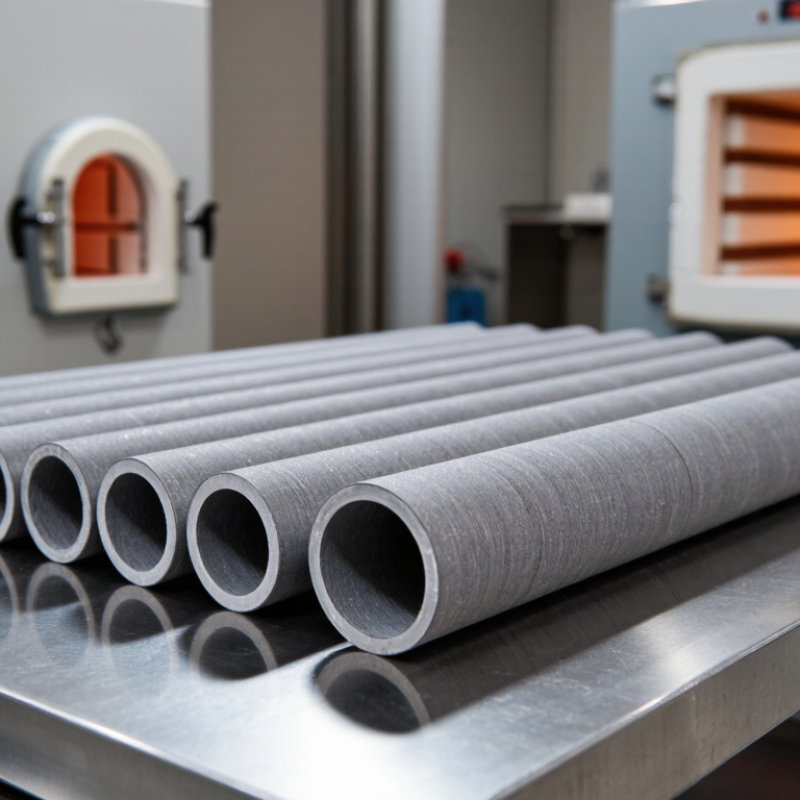
Silicon carbide tubes are valued for high hardness, low thermal expansion, and strong resistance to heat. They can tolerate rapid temperature changes better than many ceramic materials. Their performance still depends on purity, wall thickness, and surface finish. A thick tube may survive handling, but it can slow heat transfer.

Common types include reaction-bonded, sintered, recrystallized, and chemical vapor deposition tubes. Reaction-bonded grades often offer practical strength and cost control. Sintered tubes provide dense structures for demanding furnace environments. Recrystallized silicon carbide performs well at extreme temperatures, while CVD coatings can improve purity and chemical resistance. The choice is rarely simple. Design calculations must consider temperature, gas chemistry, pressure, and thermal cycling.

Industrial uses are highly specific. In heat-treatment furnaces, tubes protect heating elements and support ceramic fixtures. In semiconductor processing, high-purity tubes help limit particle contamination. Chemical plants use them in corrosive gas or liquid handling systems. Thermocouple protection is another common application. I would not treat every silicon carbide tube as maintenance-free. Brittle edges can chip during installation, and hidden cracks may grow after repeated heating. Practical inspections should include dimensional checks, visual examination, and controlled startup heating. Sealing also deserves attention. Poor connections can create leaks, uneven stress, or contamination inside the process chamber.
How to Evaluate Silicon Carbide Tube Manufacturers in China

Evaluating silicon carbide tube manufacturers in China requires more than comparing quotations. According to Yole Group’s Power SiC 2024 report, power silicon carbide demand continues expanding through electric vehicles, renewable energy, and industrial equipment. This growth increases pressure on tube suppliers to deliver stable quality, not only attractive prices.

Ask for measurable data. Check SiC purity, bulk density, open porosity, wall thickness, straightness, and thermal-shock performance. A supplier should provide batch-level test records and clear inspection methods. Request samples from several production lots. One polished sample can mislead.

I would also audit raw-material control, sintering equipment, furnace temperature uniformity, and final machining. ISO 9001 certification helps, but it does not prove tube performance. ASTM C20 testing can support apparent porosity and density checks, while application-specific thermal cycling remains essential. MarketsandMarkets projects the advanced ceramics market to grow strongly during this decade, increasing the need for traceable production systems. Still, reports often combine many ceramic categories. That limitation deserves attention. A credible manufacturer explains defects openly, accepts dimensional feedback, and provides corrective-action records. Ask about lead times, packaging, export documentation, and replacement procedures before placing a larger order. Small details matter.

China’s Top 10 Silicon Carbide Tube Manufacturers

China’s Top 10 Silicon Carbide Tube Manufacturers are increasingly evaluated through measurable engineering performance, not advertising claims. Fortune Business Insights valued the global silicon carbide market at about USD 4.32 billion in 2023, with strong growth expected through 2030. This expansion supports demand for kiln tubes, radiant tubes, thermocouple protection tubes, and semiconductor process components.

A practical top-ten assessment should examine tube density, purity, thermal-shock resistance, dimensional tolerance, and production consistency. In factory audits, buyers should request batch records, hydrostatic or pressure-test results, and temperature-cycle data. Small details matter. A tube that survives 1,600°C but warps after repeated cycles is not a reliable choice. China’s leading manufacturers often provide reaction-bonded, recrystallized, and sintered options for different furnace conditions. The Yole Group’s SiC power electronics research also projects a multibillion-dollar market by 2030, increasing pressure for cleaner and more stable ceramic processing equipment. However, public rankings remain imperfect. Some suppliers disclose detailed test data; others provide only catalogue values. That gap deserves attention. Buyers should compare samples under identical heating rates, loads, and atmospheres before final selection. Service response, machining accuracy, and replacement lead time can influence operating costs more than a small purchase-price difference.

China's Top 10 Silicon Carbide Tube Manufacturers

Typical upper service temperatures by silicon carbide tube application

This chart presents application-level engineering reference values rather than company-specific or brand-specific data. Actual service temperature depends on silicon carbide grade, atmosphere, thermal cycling, wall thickness, tube design, and installation conditions.

Product Quality, Customization, and Production Capabilities

China’s top 10 silicon carbide tube manufacturers should be judged by measurable performance, not attractive catalogs. Product quality begins with raw material purity, forming accuracy, and firing control. A reliable tube should show consistent density, smooth inner walls, and stable dimensions after high-temperature treatment. Small cracks can become serious failures inside furnaces.

Production capability matters just as much. Experienced manufacturers usually maintain controlled sintering, precision machining, and batch-level inspection. Ask for data on maximum operating temperature, thermal shock resistance, electrical behavior, and wall-thickness tolerance. A practical supplier should provide inspection records and test samples before large orders. Details matter here.

Customization separates a capable factory from a trading intermediary. Useful options include tube length, outer diameter, bore size, connection design, surface finish, and mounting holes. Engineers should review drawings carefully because a one-millimeter change can affect heat distribution or installation clearance. Prototype production also reveals communication speed and process discipline.

No manufacturer is perfect. That matters. Some factories offer excellent materials but limited machining. Others customize quickly but provide weak testing evidence. Buyers should compare sample results, production lead times, packaging methods, and replacement policies. A site audit can reveal uneven workshop cleanliness or inconsistent measurement practices. Those observations may seem minor, yet they often predict long-term reliability. The strongest manufacturers explain technical limits honestly instead of promising every specification.

China Top 10 Silicon Carbide Tube Manufacturers? - Product Quality, Customization, and Production Capabilities
Rank Typical Product Focus Silicon Carbide Type Typical Purity Range Common Tube Dimensions Temperature Capability Customization Capability Quality and Documentation Production Capability Indicators
1 Industrial furnace tubes and kiln protection tubes Recrystallized SiC and reaction-bonded SiC Approximately 98%–99.5% SiC, depending on grade Outer diameter commonly 20–180 mm; lengths up to approximately 3,000 mm Suitable for continuous service commonly up to 1,400–1,600°C in air, subject to design Custom diameter, wall thickness, length, closed ends, holes, slots, and flanges Dimensional inspection, density testing, chemical composition records, and batch inspection reports available by agreement Suitable for repeat industrial orders with CNC finishing and controlled firing processes
2 Heating-element support tubes and high-temperature electrical furnace components Reaction-bonded SiC and recrystallized SiC Approximately 97%–99.5% SiC Outer diameter commonly 15–150 mm; standard and made-to-order lengths Common operating range up to approximately 1,400°C–1,600°C in oxidizing atmospheres Customized grooves, slots, mounting holes, end machining, and surface finishing Material certificates, inspection dimensions, visual inspection, and electrical-property data where applicable Well suited to small-to-medium batch production and replacement-part programs
3 Thermocouple protection tubes and temperature-measurement components Pressureless-sintered SiC and reaction-bonded SiC Approximately 98%–99.5% SiC Typical outer diameter 10–100 mm; lengths commonly 300–2,500 mm Designed for high-temperature measurement applications commonly reaching 1,400°C–1,600°C Custom bore size, tip geometry, threaded ends, collars, mounting sections, and tolerances Dimensional, surface, density, and porosity checks; traceability can be specified in the purchase order Strong fit for engineered components requiring consistent bore alignment and repeatability
4 Heat-exchanger tubes and corrosion-resistant process tubes Reaction-bonded SiC and recrystallized SiC Approximately 97%–99.5% SiC Typical outer diameter 20–120 mm; length dependent on furnace and assembly design High-temperature service commonly up to approximately 1,400°C in suitable atmospheres Custom straightness, wall thickness, tube-sheet ends, grooves, and connection geometry Leak testing, dimensional inspection, surface inspection, and chemical-resistance data may be requested Suitable for corrosion-resistant thermal equipment and multi-piece assemblies
5 Semiconductor and photovoltaic thermal-process tubes High-purity pressureless-sintered SiC Typically 99%–99.9% SiC, with higher purity available for selected applications Commonly 20–300 mm diameter; length and wall thickness are application-specific Often designed for process temperatures around 1,200°C–1,600°C, depending on atmosphere and loading Tight dimensional tolerances, low-particle finishing, custom ports, slots, and polished or machined surfaces Particle-control requirements, surface roughness data, dimensional reports, and batch traceability can be specified Best suited to controlled-environment applications requiring higher purity and tighter process control
6 Foundry, heat-treatment, and atmosphere-control tubes Reaction-bonded SiC and recrystallized SiC Approximately 97%–99.5% SiC Outer diameter commonly 25–200 mm; standard lengths and engineered lengths available Typical continuous-use capability up to approximately 1,400°C–1,600°C, depending on atmosphere Custom internal diameter, wall thickness, end caps, slots, holes, and support features Routine dimensional inspection, visual inspection, density checks, and packing documentation Suitable for high-volume replacement parts and standard industrial furnace configurations
7 Gas-flow, burner, and combustion-system tubes Reaction-bonded SiC and recrystallized SiC Approximately 97%–99.5% SiC Typical outer diameter 20–180 mm; length commonly up to 2,500–3,000 mm Commonly used in applications operating up to approximately 1,400°C–1,600°C Custom gas ports, angled holes, flanges, threaded sections, and multi-opening designs Dimensional reports, pressure or leak testing, visual inspection, and material documentation available by requirement Useful for engineered-to-order combustion and high-temperature gas-handling systems
8 Wear-resistant and chemical-process tubes Pressureless-sintered SiC and reaction-bonded SiC Approximately 98%–99.5% SiC Typical outer diameter 10–150 mm; wall thickness selected according to wear and pressure conditions High-temperature capability commonly up to approximately 1,400°C in suitable operating conditions Custom internal diameter, surface finish, tapered sections, grooves, and connecting ends Hardness, density, dimensional inspection, surface inspection, and chemical-resistance documentation may be available Appropriate for abrasive slurries, corrosive media, and demanding process environments
9 Laboratory furnace and pilot-scale equipment tubes Recrystallized SiC and pressureless-sintered SiC Approximately 98%–99.9% SiC Typical outer diameter 10–120 mm; short and medium-length tubes are common Commonly suitable for laboratory and pilot processes up to approximately 1,500°C–1,600°C Low-volume custom production, special end shapes, observation openings, holes, and tight dimensional requirements Dimensional inspection, visual inspection, surface-finish data, and material certificates available on request Flexible for prototypes, research equipment, replacement parts, and low-volume engineered orders
10 Custom ceramic tubes for machinery and thermal-processing systems Reaction-bonded, recrystallized, and pressureless-sintered SiC Approximately 97%–99.9%, depending on material system and application Typical outer diameter 10–200 mm; length, wall thickness, and tolerance are project-specific Application-dependent service commonly ranging from 1,200°C to 1,600°C Prototype-to-production support, CAD-based manufacturing, CNC machining, custom tolerances, and complex openings Inspection plans, dimensional reports, material certificates, packaging specifications, and traceability can be agreed in advance Suitable for OEM projects requiring design support, sampling, and repeat production
Technical ranges are representative industry values for silicon carbide tubes manufactured in China. Actual purity, dimensions, temperature rating, tolerances, testing, and production volume vary by material grade, manufacturing process, atmosphere, and application; final specifications should be confirmed with the selected supplier.

How to Select the Right Chinese Silicon Carbide Tube Supplier

China’s top ten silicon carbide tube manufacturers may look similar online, but supplier selection requires closer inspection. Silicon carbide tubes serve furnaces, heat exchangers, and demanding chemical environments. Their performance depends on purity, density, dimensions, and machining accuracy. An impressive catalog is not enough. Ask for recent test reports, production photos, and clear material specifications. In factory audits, I have found that small details often reveal larger quality risks. Check whether the supplier controls forming, sintering, grinding, and final inspection internally.

Tips: Compare technical data carefully. Confirm the tube’s operating temperature, wall thickness, tolerance, and expected service life. Request samples from the same production line used for bulk orders. Review packaging methods, because chipped edges can begin during transport. Ask how rejected pieces are recorded and handled. Good answers should be specific, not merely confident.

Communication also matters. A dependable Chinese supplier should explain lead times, inspection steps, replacement policies, and export documents clearly. Verify whether drawings are reviewed before production begins. One oversight can create costly installation problems. Samples may perform well, yet consistency across a full batch can still be uncertain. Discuss batch testing and independent inspection when the application is critical. Keep written records of every agreed specification. This matters. A supplier that welcomes technical questions usually supports more reliable cooperation, although no manufacturer is perfect. My own selection process still needs refinement, especially when comparing long-term data with short sample tests.